
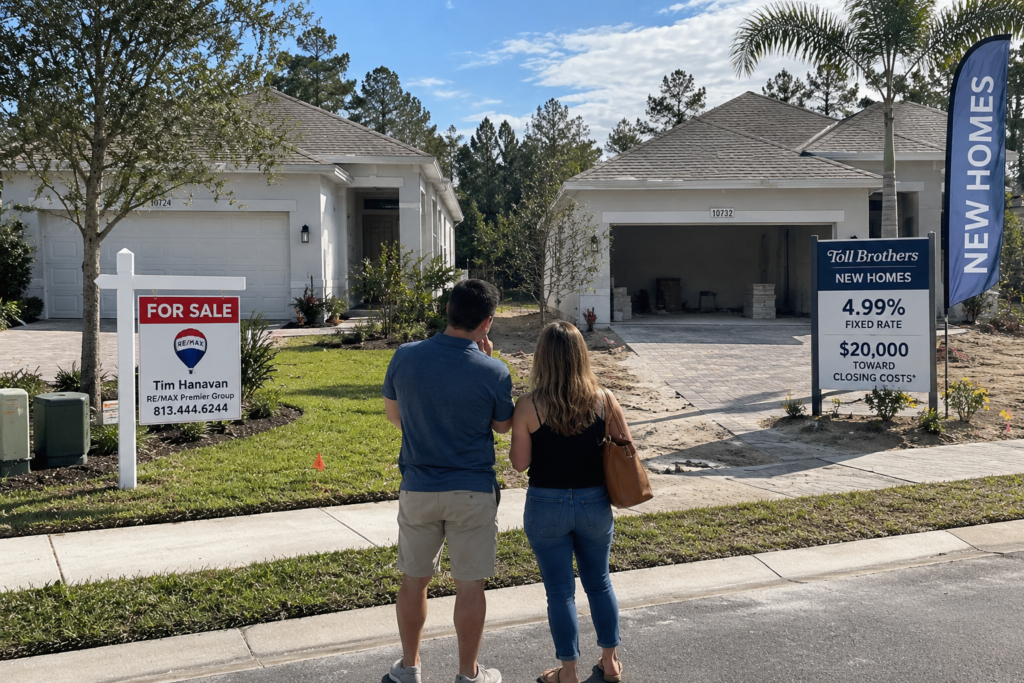
A new home can be pretty appealing. You find a floor plan you like, choose a community that fits your needs, and perhaps the builder offers financing incentives that make the purchase even more attractive.
But there’s a question I encourage buyers to consider before making that commitment.
What happens if you need to sell that home sooner than you expected?
Life changes. A job relocation, family situation, or financial change can turn a home you expected to own for years into one you need to sell after only two or three.
And if you’re selling a recently built home, you may discover that your biggest competitor is the same builder who sold you the house.
That’s why I generally encourage buyers to consider at least a five-year ownership horizon. Five years isn’t a guarantee of making money or even breaking even. It’s a planning guideline worth considering before you purchase.
Your Biggest Competitor May Be the Builder
Imagine purchasing a new home in a community where the builder is still selling.
Two years later, you need to move.
Your home is in excellent condition. You’ve maintained it, perhaps made improvements, and you’re ready to sell.
Unfortunately, the builder is offering the same floor plan down the street.
And the builder has incentives you probably can’t match.
Perhaps they’re offering $20,000 toward closing costs, a mortgage rate below what’s available through traditional financing, or reduced prices on remaining inventory.
Now put yourself in the buyer’s position.
They can purchase your two-year-old home or a brand-new one with attractive financing and money toward closing costs.
Which would you choose?
Your home may have advantages. Perhaps you have a better lot, improvements the builder charges extra for, or immediate availability.
But buyers compare the entire financial picture, not simply the asking price. That can put a resale homeowner at a disadvantage.
Sam’s $40,000 Lesson
I worked with a homeowner I’ll call Sam, who needed to sell within two years of purchasing new construction.
By the time Sam needed to move, the market had flattened, and the builder was offering his same model for less than Sam had originally paid.
That was only part of the problem.
Traditional mortgage rates were around 6%. The builder was offering 4.99% financing along with $20,000 toward closing costs.
The builder wasn’t simply competing on price. They were helping buyers reduce their upfront expenses and potentially their monthly payments.
Sam couldn’t offer that same package without making substantial financial concessions.
We evaluated what his home could realistically sell for, considering the builder’s competition. Then we accounted for his mortgage payoff and selling expenses.
Sam faced a shortfall estimated at more than $40,000.
He needed to move. He sold the home and brought the money necessary to close.
His assessment afterward was simple.
“Lesson learned.”
Sam hadn’t purchased expecting to sell two years later. But circumstances changed, and the financial consequences were significant.
Why the First Five Years Can Be Financially Difficult
Many buyers I work with purchase homes with down payments of 10% or less.
There’s nothing inherently wrong with that. But it means they begin ownership with relatively little equity.
When they sell, the proceeds must cover their mortgage balance and selling expenses. Depending on the transaction, there may also be negotiated contributions toward buyer closing costs or repairs.
Meanwhile, a substantial portion of the early payments on a typical mortgage goes toward interest rather than reducing principal.
If the home’s value hasn’t increased enough to offset those expenses, selling may require bringing additional money to closing.
Why might five years make a difference?
For one thing, the builder may have finished selling in the community. You’re no longer competing directly against their financing incentives.
You’ve also had more time to reduce your mortgage balance. And property values may have appreciated or recovered from a weaker market.
But none of those outcomes is guaranteed. Some builders remain active much longer, and property values can decline.
Another financial consideration with new construction is the potential increase in property taxes after the first year, something buyers should understand before committing to a purchase.
Five years isn’t a magic number. It’s a useful point for evaluating whether the purchase fits your anticipated plans.
What I Recommend Before You Purchase
When I’m working with someone considering new construction, I want them to understand more than the purchase price and monthly payment.
Having your own REALTOR® when buying new construction can also help you evaluate the builder’s incentives, contract terms, and potential risks before making a commitment.
I also want them to consider what happens if they need to leave.
One way I do that is by comparing what the builder is offering with what a homeowner might realistically receive when selling a comparable resale property.
Then I prepare a seller net sheet.
That estimate considers the likely selling price, mortgage payoff, selling expenses, and other applicable costs. It helps illustrate what the homeowner might walk away with—or potentially need to bring to closing.
If the builder is offering substantial incentives, that’s often where I raise the red flag.
You may want to reconsider the situation.
For someone anticipating a move within three to five years, we might compare new construction with existing resale homes. A resale isn’t automatically safer, but it may not face the same direct competition from builder incentives.
If someone expects to stay less than three years, renting may also deserve consideration.
Sometimes new construction is the most affordable option initially, particularly when the builder’s financing incentives are attractive. But affordability today and the financial flexibility to sell tomorrow are two different considerations.
My recommendation depends on the buyer’s circumstances and available alternatives. There may be situations where I wouldn’t recommend new construction at all.
Sequence Matters: Consider the Exit Before the Purchase
One of the principles I’ve developed over my years in real estate is that the order in which you make decisions can significantly affect your options.
Buying new construction is a good example.
Before purchasing, consider how long you realistically expect to stay, what might cause those plans to change, and whether the builder is likely to remain active in the community.
Most importantly, consider whether you would have the financial flexibility to sell if the market didn’t cooperate.
You may decide that new construction is still the right choice. That’s reasonable when you understand the risks and alternatives.
But discovering those risks before purchasing gives you choices that may no longer be available two years later.
And if you already own a recently built home and need to move, the first step is understanding what your property could realistically sell for and what the financial outcome would look like.
The goal isn’t to predict everything that might happen. It’s to make today’s decision with a clearer understanding of what tomorrow could require.