
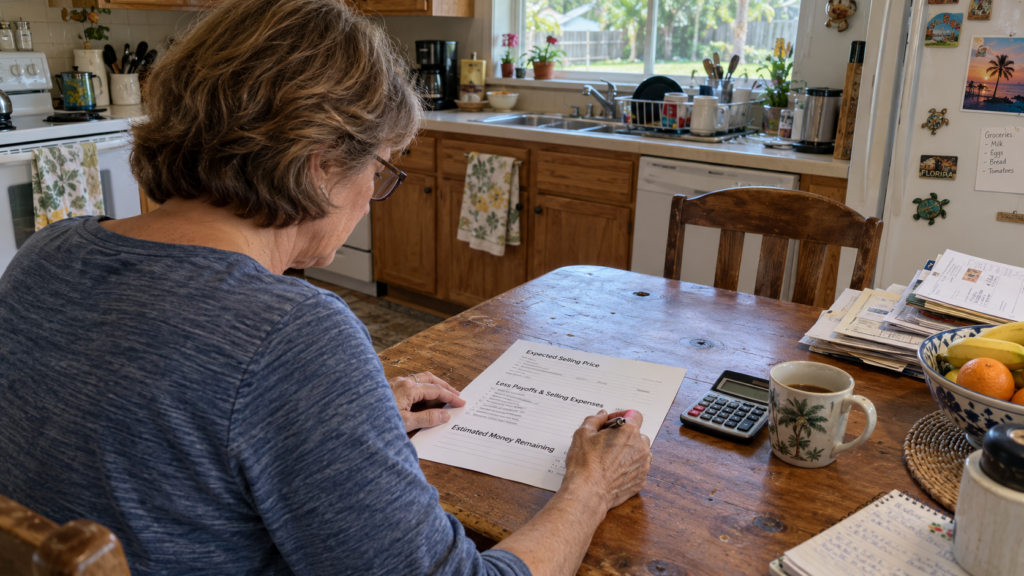
What your home sells for and what you walk away with are two different numbers.
To estimate what you will receive, we need a realistic selling price, the debts that must be paid, and the expenses associated with the sale. Before you build plans around that money, we also need to understand which figures are reasonably established and which could change.
My starting point is conservative. I would rather help you plan around a cautious estimate than have a conversation later about why the sale did not provide what you needed for your next chapter.
Value, equity, and proceeds tell you different things
Your home’s market value is an estimate of what a buyer is likely to pay. Your equity is that value minus the debt secured by the property.
Your net proceeds are what remains after those debts and the expenses of selling are paid.
Here is a simplified, hypothetical example:
| Item | Amount |
|---|---|
| Selling price | $500,000 |
| Mortgage payoff | −$250,000 |
| Selling expenses and adjustments | −$35,000 |
| Estimated net proceeds | $215,000 |
The homeowner might initially have counted on $250,000 in equity. In this example, estimated proceeds are $215,000.
The $35,000 is an illustration, not a standard charge or an estimate for your home. Your expenses depend on your property, agreements, and transaction.
Start with what a buyer is likely to pay
A useful proceeds estimate begins with a supported selling figure.
With nearly 17 years in real estate and the tools available to prepare a comparative market analysis, I can generally get close to what I believe an appraisal is likely to support. That remains my assessment, not a guaranteed appraisal result.
Then I examine market conditions. How long are comparable homes taking to sell? What have they sold for recently? What competition would your home face?
Next comes what I call the home’s “unique nature.” Two homes with the same floor plan can offer different things. The neighborhood’s location, the home’s position within it, conservation behind the property, and distinctive features can influence buyer interest and value.
Condition matters, too. In a quiet market, buyers may have more choices and be less willing to take on work. In a fast-moving market, condition still matters, but its influence may be less pronounced.
Together, those factors help me assess what a buyer is likely to pay.
I can market a home extensively and show it in its best light. I cannot control what buyers, collectively, are willing to pay. Pricing above their expectations can extend the selling time. Pricing well above them can leave a home sitting.
Your listing price and your planning figure are separate decisions
You may want to try a higher listing price. We can discuss the reasoning and tradeoffs.
But I would not automatically use that price to estimate the money available for your next move.
For planning, I use a cautious figure suited to your situation—no higher than the price my analysis suggests a buyer will likely pay. If we list higher and achieve more, you have additional proceeds to work with.
That conservative figure is still an estimate. It is not a promised minimum. Its purpose is to avoid making your next chapter depend on the most optimistic outcome.
Account for each issue once
Selling expenses can include mortgage and other secured-loan payoffs, agreed brokerage compensation, closing charges, applicable taxes and prorations, and negotiated buyer contributions or credits.
I also assess likely buyer concerns: roof age, heating and cooling systems, water heater, appliances, pool condition, and other property-specific issues.
Those concerns need to appear in the financial picture, but we should account for each issue once.
If you address a condition issue before selling, that expense belongs in your preparation budget. If you leave it for the buyer, we may account for it in a lower expected selling price. A negotiated credit is another possibility.
We also use marketing to communicate the home’s condition and set expectations. That cannot guarantee a buyer will accept every issue without further negotiation.
This is where experience and judgment matter. The parts may move around as the sale develops. We need to track those changes without counting the same issue twice—or overlooking a new expense.
Test the estimate against actual offers
The initial calculation is a forecast. Actual offers give us more specific information.
A seller net sheet estimates what a particular offer would leave you after anticipated deductions. It helps explain why the highest offer price does not always produce the most money.
For example, $510,000 with a $15,000 seller contribution leaves $495,000 before other expenses. An offer of $500,000 without that contribution leaves $500,000 before other expenses.
As negotiations, inspections, and closing preparations progress, we update the calculation with better information.
An open line of communication is essential. You should understand what changed, why it changed, and how it affects your choices.
Decide what the money needs to do
The proceeds from your sale may need to cover more than your next down payment.
Moving, purchase closing expenses, immediate repairs, and cash reserves may all matter. Preparation expenses you paid before closing also belong in your overall budget, even when they do not appear on the closing statement.
The amount you receive and the amount you choose to commit to your next home do not have to be the same.
Before making commitments, establish a conservative proceeds estimate and consider what that money needs to accomplish. Then keep testing the plan as the information becomes clearer.
You do not need to have decided to sell to begin. Understanding what you could reasonably walk away with may help you decide whether moving makes sense in the first place.